
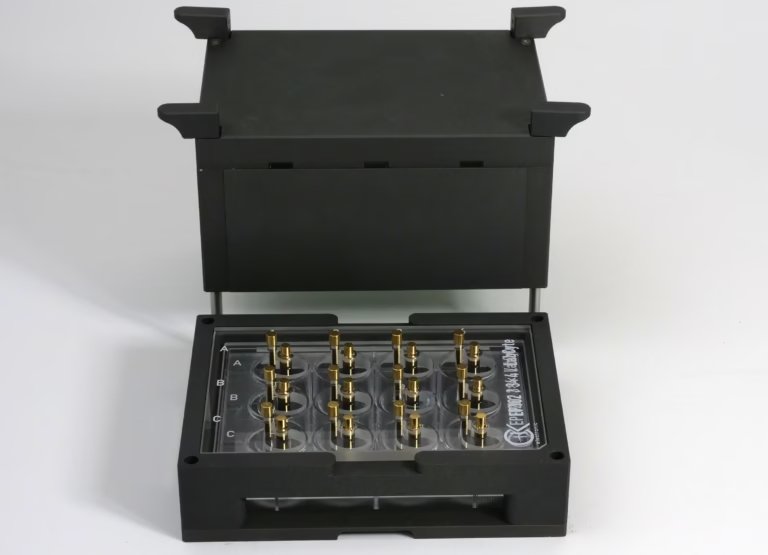
Modern laboratories depend on accurate barrier integrity testing. This is where an automated Teer measurement system plays a crucial role. Researchers use it to examine the efficacy of epithelial and endothelial layers of cells in regulating the movement of ions and molecules. By providing consistent readings without manual errors, an automated Teer measurement system has become a trusted tool for advanced in vitro research.
What Teer Actually Measures
There is trans epithelial electrical resistance or trans endothelial electrical resistance. It gives a numerical value which indicates the intensity and integrity of a cell barrier. To achieve this researchers often depend on an Impedance-based Teer Measurement system. In this system, the alternating current is applied to the cell layer in a gentle manner and the voltage change is measured. Based on this, it determines the resistance and impedance which informs scientists on the performance of the barrier. The Impedance-based Teer Measurement system is widely praised because it captures both resistive and capacitive properties of the cell layer.
How Automation Enhances the Process
Robotics streamline all the steps. The cells are then cultured on inserts or on well plates till they develop a complete barrier. Electrodes are attached on the top and to the bottom of the cell layer when it is ready. The software comes into play. It delivers a manipulated current, determines voltage, signals the data and calculates Teer values. In an automated Teer measurement system these steps happen repeatedly without human involvement, which provides a smooth and dependable workflow. Data is also stored in the system, and they can plot trends with time, as well as alert the researchers in cases where the readings are out of the expected range.
Why Impedance-Based Systems Offer Richer Insights
The conventional approaches to reading resistance offer merely one side of the coin. By contrast an Impedance-based Teer Measurement system analyses multiple frequencies, allowing it to separate resistive and capacitive elements. This provides information on tight junction integrity, membrane behaviour and cell health generally. Automation combined with impedance techniques allows researchers to conduct long term experiments, drug testing, toxicity testing and model testing with more confidence.
The Value of Consistency and Precision
The elimination of user-related variation is one of the greatest benefits of automation. Manualized processing tends to create uneven electrode location or realise random timing. Such minor variations can alter outcomes considerably. With an automated Teer measurement system measurements are taken at fixed intervals under controlled conditions. This makes the results of the conclusions made using the data dependable and supported by accurate measurements.
Real Use Cases in Laboratory Research
Automation is particularly useful to researchers dealing with permeability testing and drug screening and maturation studies of barriers. The system enables them to keep track of Teer hour by hour without disrupting the culture. They are also capable of detecting possible signs of barrier breakdown early and responding promptly. This renders the technology a powerful tool to any lab that seeks to generate quality data.
Conclusion
The way these systems operate explains the reason why they are becoming significant in contemporary research. They integrate automation, impedance analysis and intelligent programmes to provide reliable barrier integrity measurements. In case you are interested in enhancing your laboratory and using the equipment which is aimed at precision and effectiveness, contact Medelink to consider our sophisticated solutions to Teer analysis.